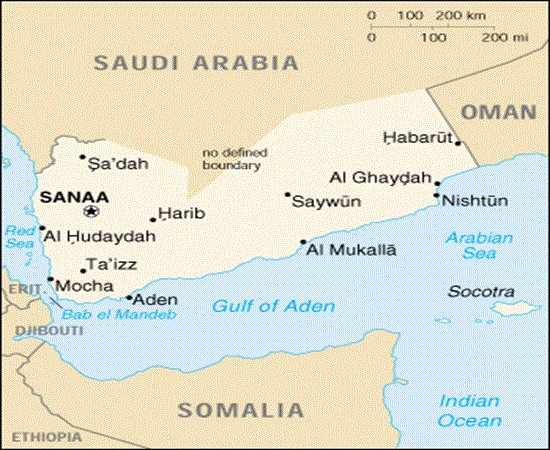
Yemen map


WIKIMEDIA COMMONS

license details


Shaul Shay

(Senior research fellow at the International Institute for Counter-Terrorism (ICT) at the Interdisciplinary Centre Herzliya and former deputy head of Israel’s National Security Council)

Copyright: @ 2026 Research Institute for European and American Studies (www.rieas.gr) Publication date: 20 September 2026

Note: The article reflects the opinion of the author and not necessarily the views of the Research Institute for European and American Studies

In September 2026 the Iranian backed Houthis launched a lightning offensive against Saudi-backed government forces along the southwestern coastal plain. Within a week the Houthi forces gained control over the Red Sea coast of Yemen and the vital Bab al-Mandeb Strait. This marks the deadliest and most intense fighting in the country since the collapse of the 2022 UN ceasefire. ... Read more

oceanStella Kyvelou
(Professor of Strategic and Maritime Spatial Planning and expert on the blue economy in the Eastern Mediterranean)

Copyright: @ 2026 Research Institute for European and American Studies (www.rieas.gr) Publication date: 20 September 2026

Note: The article reflects the opinion of the author and not necessarily the views of the Research Institute for European and American Studies

One of the most interesting statements in Ursula von der Leyen’s recent State of the Union address may have been somewhat overshadowed by her politically striking proposal to pave the way for Canada to become the European Union’s first “associate member”. .... Read more

waterDr Georgios Niveroglou
(Retired Brigadier General of the Hellenic Army and a former Director of the Military Office of the Minister of National Defence. He holds a doctorate from the National and Kapodistrian University of Athens, where he is now a postdoctoral researcher, and a master's degree in Applied Strategy and International Security from the University of Plymouth. His work focuses on the geopolitics of water, the security of critical infrastructure, and strategic communication.)

Copyright:@2026 Research Institute for European and American Studies (www.rieas.gr) Publication date: 13 September 2026

Note: The article reflects the opinion of the author and not necessarily the views of the Research Institute for European and American Studies.

In the last days of July 2026, hackers reached into the operational technology of drinking-water utilities across at least a dozen American states,. .... Read more

africa2Bouzemouri Achraf
(RIEAS Senior Analyst)

Copyright: @ 2026 Research Institute for European and American Studies (www.rieas.gr) Publication date: 13 September 2026

Note: The article reflects the opinion of the author and not necessarily the views of the Research Institute for European and American Studies.

Introduction

Water has increasingly become one of the most consequential strategic resources in Africa. Across a continent marked by considerable hydrological diversity, the challenge is not simply the absolute absence of water, but its uneven distribution, seasonal variability, limited accessibility and increasingly contested use. ... Read more

drone1John M Nomikos
(RIEAS Executive Director)

Copyright: @ 2026 Research Institute for European and American Studies (www.rieas.gr) Publication date: 7 September 2026

Note: The article reflects the opinion of the author and not necessarily the views of the Research Institute for European and American Studies

On 11 May 2026, the United Nations High Commissioner for Human Rights, Volker Turk, warned that armed drones had become "by far and away the leading cause of ci-vilian deaths" in Sudan's war, killing at least 880 civilians between January and April of this year and accounting for more than eighty percent of recorded civilian fatalities in that period.1 The statistic deserves closer attention than it has received in European capitals, because some of the aircraft now driving Sudan’s increasingly lethal drone war originated in the factories of a NATO member state.... Read more

EU2Europe has decided that defending is no longer enough. The strategy it is reaching for has two edges, and one of them can be taken up now, at low cost, by nearly everyone already in the fight.

By Celia D. Hanley
(Founder and President of Catalina Intelligent Solutions LLC (CatalinaIQ). A former Senior Operations Officer of the Central Intelligence Agency and the Defense Intelligence Agency, with over forty years in clandestine operations, counterintelligence, and international security, she now develops cognitive security and risk mitigation programs for private-sector, government, and academic audiences.)

All statements of fact, opinion, or analysis expressed are those of the author and do not reflect the official positions or views of the U.S. Government. Nothing in the contents should be construed as asserting or implying U.S. Government authentication of information or endorsement of the author's views. This article is based entirely on open-source, unclassified information.

Copyright: @ 2026 Research Institute for European and American Studies (www.rieas.gr) Publication date: 7 September 2026

Note: The article reflects the opinion of the author and not necessarily the views of the Research Institute for European and American Studies

Something has shifted in how Europe talks about hybrid threats. For most of the past decade the language was defensive: resilience, situational awareness, protection of critical infrastructure. In the first months of 2026 that changed. The European Council on Foreign Relations published a strategy titled from shield to sword. On 16 March 2026 the Council of the European Union committed the bloc to prevent, deter, and respond to hybrid campaigns irrespective of their origin, scale and intensity, and weeks earlier it had sanctioned six individuals for information manipulation.... Read more on the Article and Read more on CatalinaIQ Profile