trir9Authors
Ataallah Abdi 1
Yadollah Karimipour 2
Abdolreza Faraji rad 3
Zahra Saee 4
1 Assistant Professor of Political Geography, Kharazmi University, Tehran, Iran
2 Professor of political geography, Kharazmi University, Tehran, Iran
3 Associate Professor of Geography, Islamic Azad University, Research and Sciences Branch, Tehran, Iran
4 Ph.D. Candidate in Political Geography, kharazmi University, Tehran, Iran

Copyright @ 2025 https://journal.iag.ir/article_105237_en.html
Reposted at RIEAS in 20 December 2025.

Note: The article reflects the opinion of the authors and not necessarily the views of the Research Institute for European and American Studies

Introduction

Iran and Turkey are the two most important players in the Middle East and the Islamic world with a long-standing relationship with each other. With the collapse of the Ottoman Empire, Turkey was formed from the remains of the Ottoman Turks as a modern nation. In this new era, Iran-Turkey relations entered a new phase. With the advent of the Islamic Revolution, relations between Turkey and Iran were on the ups and downs. ... Read more
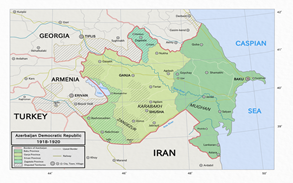
Map of the Azerbaijan


WIKIMEDIA COMMONS


Licence details


Farid Shukurlu, LL.M.,

(RIEAS Non-Resident Fellow)

Copyright: @ 2026 Research Institute for European and American Studies (www.rieas.gr) Publication date: 21 July 2026

Note: The article reflects the opinion of the author and not necessarily the views of the Research Institute for European and American Studies

Abstract

Following Azerbaijan's military victory in the Second Karabakh War, the country has emerged as a post-conflict state seeking to reorient its foreign policy towards economic development and sustainability. Azerbaijan's policy of active non-alignment enables Baku to pursue an independent foreign policy across its broader neighbourhood, from the Middle East to the Eastern Mediterranean, while advancing initiatives aimed at strengthening regional connectivity, enhancing regional security, and facilitating the energy transition.... Read more

Copyright © 2019 Kassandros. All rights reserved- Reproduction permitted provided the author www.kassandros.gr is mentioned. Publication at RIEAS web site (www.rieas.gr) on 21 December 2019.

The advancing decomposition of the State of Iraq illuminates the evolution of the instability in the greater Middle East area. Both Iraq and Syria were greatly tested by the explosive growth of the fighting ISIS. Syria managed to survive it thanks to the simultaneous support of Russia, Iran, and Syrian Kurdish Forces, Iraq lost Iraqi Kurdistan and managed to survive ISIS with the support of the Shia Militias of Iraq, which developed their strength with the ideological, financial and material support of Iran. Read more

Shaul Shay
(Senior research fellow at the International Institute for Counter-Terrorism (ICT) at the Interdisciplinary Center Herzeliya (IDC) and former Deputy Head of Israel National Security Council)

Copyright:
Research Institute for European and American Studies (www.rieas.gr) Publication date: 20 April 2020

Note: The article reflects the opinion of the author and not necessarily the views of the Research Institute for European and American Studies (RIEAS)

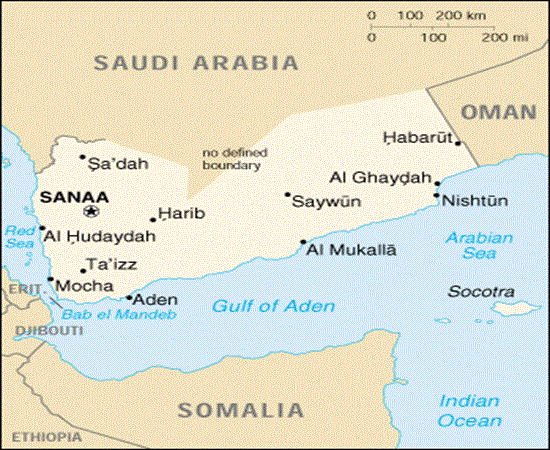
The Houthis rebels, backed by Iran took Sanaa by force in 2014, overthrowing President Hadi and heading south and east, with the assumption they could take over the whole country. Saudi Arabia and the coalition forces launched a war in March 2015 to uproot the Houthis from Sanaa and restore President Hadi to power. The conflict, widely seen in the region as a proxy war between Saudi Arabia and Iran. After five years of fighting, neither the Hadi government and the Saudi led coalition nor the Houthi insurgents have accomplished their original goals...Read more

Aleksander Olech
(RIEAS Research Associate, & Phd Candidate, War Studies University, Poland)

Copyright: Research Institute for European and American Studies (www.rieas.gr) Publication date: 20 April 2020

Note: The article reflects the opinion of the author and not necessarily the views of the Research Institute for European and American Studies (RIEAS)

Abstract

From the beginning of the 21st century, terrorism has been evolving to take the form of various acts of violence committed by terrorists. It is characterized by close relation to history and the political situation in the world. The development of research on security in the 21st century in Europe clearly shows that security is an independent research discipline whose main goal is to obtain a multi-faceted, profound and synthetic picture of reality, perspectives and threats. Due to this, it is vital to analyse contemporary threats for Central Europe.

Currently, Western European countries are struggling the most with intra-state terrorism. Its effects lead to the destabilization of national integrity and threaten social security. This situation is also important for neighbouring countries and international organizations they belong to, such as the European Union or NATO. Moreover, terrorism is growing in the Balkans and the Caucasus region. The emerging threats make Central Europe vulnerable on all sides...Read more

Quentin de Pimodan
(Member, International Advisory Board, Research Institute
for European and American Studies (RIEAS), Athens, Greece )

Copyright: Research Institute for European and American Studies (www.rieas.gr) Publication date: 18 July 2020

Note: The article reflects the opinion of the author and not necessarily the views of the Research Institute for European and American Studies (RIEAS)

One common characteristic the Gulf Cooperation Council and the European Union share as of today, is their lack of ability to coordinate their foreign policies. Forcing both to act in smaller “units” composed of several members of their respective unions. If internal mechanisms can still reveal efficient cooperating platforms on issues of common interests (military trainings , anti-corruption , culture , maritime security ), the competing goals among countries push them to favor bilateral engagements rather than multilateral platforms. It is in that vein that several countries of the GCC and of the EU are now deepening their ties outside of the unions’ frameworks and based on short-terms convergence of interests. Another common characteristic both unions share, is the acknowledgement of the United-States’ disengagement from the Gulf region, and the strong hints of US’s willingness to reduce its presence and support to its EU partners . ..Read more

We use cookies

We use cookies on our website. Some of them are essential for the operation of the site, while others help us to improve this site and the user experience (tracking cookies). You can decide for yourself whether you want to allow cookies or not. Please note that if you reject them, you may not be able to use all the functionalities of the site.